
Strong (HR) Women Lift Each Other Up

mobamaMarch is Women’s History Month. Since this is a blog (primarily) about HR, I started thinking about the women I have known throughout the history of my HR career. See what I did there? All of my previous managers (for full-time jobs) have been women. That makes sense considering 76% of Human Resources Managers are women, according to 2014 statistics from the US Department of Labor. However, the manager who started me on this HR road was a male manager I had for a non-HR job. To this day I remember him as my most supportive manager. He saw something special in me and committed to helping me succeed in my career, to the point that when he switched agencies, he found a job for me in his new agency. That job was my  first HR position (though it was called personnel.)

As I sit here pondering the significance of women in my career, I realize I’ve never had a woman manager who did the same. Don’t get me wrong- I pretty much owe my career to women because it’s been a woman who has hired me for each position I’ve held. But after that male manager I had many moons ago, I haven’t had one who really seemed invested in my career or in seeing me grow/get ahead, outside of how it would benefit them. I’ve often wondered if the outcome would have been different if I’d had more male managers.

Which leads me to this – HR is a woman-heavy industry but are there too many women? Wait, before you hate.  I have some AMAZING women HR professionals in my network who have been quite encouraging. However, when it comes to actually working with women in the same workplace, I really haven’t felt the same level of support. The women who look out for me most in my career are typically not in HR. Odd, right?

Maybe this experience is unique to me. I don’t know. Sometimes I just wonder if too many women in HR are so busy fighting for respect, equality, a voice, and a crack in the glass ceiling that the time isn’t there to nurture and support. Sometimes I wonder if it’s a fear of perceived competition. Not so fun fact: Even though we work to establish salary ranges and attempt to ensure pay equity for others, we’re STILL paid far less than our male counterparts (40% less for Managers and 38% less for other HR Professionals based on the aforementioned 2014 DOL statistics.) So yeah, I get it. Times are hard.

Of course I don’t really think there are too many women in HR. At least I don’t think I really think that.  As I said,  this whole experience could be unique to me and/or the people I’ve worked with. Perhaps everyone else has had amazing, supportive women mentors in their HR careers. Or been one. But I wonder…

If you’re reading this and you’re an HR professional, particularly if you’re a woman, I encourage you to reflect on the women who have helped/encouraged you in your career as well as the women you have helped/encouraged. If that number is small, or zero, there’s an opportunity for change.

       Image result for women supporting each other quotesImage result for women supporting each other quotesImage result for women supporting each other quotes

I leave you with the following video of rapper Remy Ma which was posted by Marie Claire in celebration of Women’s History Month. The video inspired me to write this post because women have enough problems in the world, the least we can do is help each other when we have the chance, in our personal and professional lives.

DISCLAIMER: Mild adult language. Don’t watch if you have easily offended sensibilities. Might be NSFW depending on where you work. If you’re in an open office space, wear earphones.
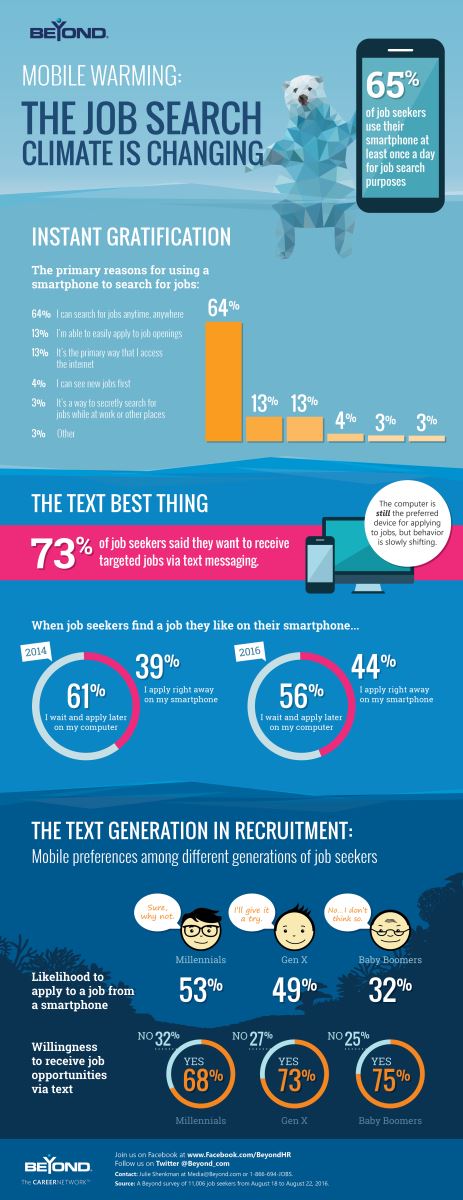


The #JobSearch Climate is Changing (Infographic)

A couple of weeks ago I attended a webinar presented by BEYOND on The Text Generation of Recruitment. In this webinar the presenter discussed the benefits of using texting as part of your recruitment strategy. One of the best reasons given was that people are on their phones ALL THE TIME. Some of the stats given included:

74% of job seekers use a mobile device in their job search. 

Text messages have an open rate of 99% vs. email open rates of 20%.

Recruiting texts have a 15% average response rate within the first hour after sending.

I took a lot of notes but basically, it’s worth weighing the pros and cons and considering whether texting makes sense for your recruitment strategy if you want to have the best chance of reaching people where they are.

As a follow-up, BEYOND sent some additional resources via email, including this lovely infoographic. Y’all know I can’t resist a good infographic and since sharing is caring, I’m sharing it with you. Enjoy!

mobilewarming

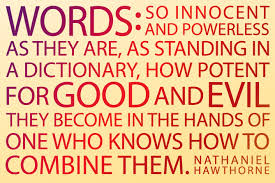
WordsMatter: The Power of Language at Work

I was inspired to write this post for a few reasons. I recently listened to a webinar titled “The State of Performance Management: What’s Broken and How to Fix It” and I found myself agreeing with a lot of what was being said. More than a lot actually. Pretty much all of it.

The presenter, Kevin Eikenberry, explained that one of the main things wrong with performance management is the term itself. To paraphrase him, we use terms like performance management/evaluation/review/assessment but people don’t want to be managed, evaluated, reviewed or assessed. The terminology alone puts people on the defensive, and leads to anxiety and stress. Who needs more of either? Do you? I certainly don’t. So ultimately it doesn’t get done or it keeps getting put off until the last minute and then it’s done half-heartedly and the results are worthless.

words matterHe suggested that instead we use the term Performance Development. Makes sense, right? After all, the process should, ideally, be designed to assist employees in knowing what they’ve done well and making them aware of areas for professional development. The process should also include a plan (i.e. action items) for that development to occur. The process should be positive, or at the very least not negative or demeaning and above all it should be useful. A phrase I read recently in regards to providing feedback is that it should be personalized but not personal.  I agree.
We hear a lot these days about the death of the traditional performance review. Well, that’s a death I won’t be mourning. The terms currently used (see above,) and thus the associated processes, tend to be neither positive nor useful. When people are told they are being managed, evaluated, etc. it automatically puts them in the mindset of being subordinate. When someone is tasked with managing, evaluating, etc. another person, it automatically puts them in the mindset of that person being subordinate to them.

Subordinate (definition):

  1. lower in rank  or position 
  2. a person under the authority or control of another within an organization
  3. treat or regard as of lesser importance than something else

Eeek! Unless you’re in the military or in prison this dynamic sounds pretty undesirable and unnecessary to me. Should there be some type of objective metrics to gauge performance as well as strengths and opportunities for development? Sure. But the process needs to change and it starts with the nomenclature.

Don’t even get me started on rating (for lack of a better term) people on expectations that aren’t clearly defined. (Meets or exceeds? How about what are they?? ) Or rating based on the recency effect i.e things that happened a short time prior to when the review is being done vs. the entire review period. (Great all year but made a mistake last month? No soup for you!) Or subjectivity vs. objectivity. (Self-explanatory.) There is a lot to talk about but this post is about words.

Another thing that inspired me to write this post was my own 2015 “performance evaluation.” I reread it the other day in preparation for the 2016 version. To say I took issue with quite a bit of it would be an understatement. Not because I think I have no room for improvement or can’t take constructive criticism, but because most of the criticisms weren’t actually constructive. They were primarily personal and subjective judgments rather than objective, work-related statements that could be supported by facts or examples.

This may sound like hyperbole but when I asked for examples of stated actions/behaviors that I considered to be negative I didn’t receive any. Not. Even. One. When I explained what the words being used to describe me implied, I was told “I didn’t mean that, I meant this.” However, that is what was written down and what will be attached to my employment file, without further explanation or clarification. So yeah, I was none too happy about the whole thing and I’m not looking forward to doing it all over again.

wordsI also got to thinking about the general terminology we use to describe relationship dynamics in the workplace. Boss. Manager. Superior. Subordinate. (See above.) Who came up with these?? I have never and will not ever refer to another person as my boss or superior. I’m just not built that way. In using those types of terms you are subconsciously (consciously, for some) indicating that a person is better than you and/or has power over you. Some people may be fine with using those terms but in my opinion, it’s an unhealthy dynamic. As you think, you will speak. As you speak, you will do. Ever heard of the phrase, speaking truth to power? Well, when the words you use are demeaning to yourself or others, those words will manifest as beliefs and actions.

Some may say I’m taking this too far but think about it. If you are currently using any of these terms in the workplace, try to stop using them, in both written and verbal communication. Remove them from official documentation, policies and procedures. When people stop hearing and seeing these and other similar words that denote an unnecessary and unbalanced power dynamic, I believe we will see a significant shift for the better. (Hierarchy may be necessary for the purpose of organizational structure but that doesn’t mean it has to be part of the organizational culture.)

Your assignment, should you choose to accept it, is to be a change agent and turn your performance management process that doesn’t work (trust me, it doesn’t) into a performance development process. I’m sure morale and productivity among your employees will begin to improve, even if it isn’t bad to start with. And if it doesn’t, at lease you tried. If it’s not within your purview to change terminology and processes and/or shift culture on an organizational level, try doing it on a department level or on a team level. Whether you effect change on an organizational, departmental or individual level, every journey begins with a single step. Never forget, WORDS MATTER.

ICYMI: LinkedIn Posts For the Win! #HR

I know it’s been a while since I’ve shared a blog post here. So many ideas, so little time. I have promised myself to make blogging, and other professional brand & career building activities more of a priority. I have a few things still in draft mode that will be coming out soon. In the meantime, I thought I’d share a few of the posts I’ve written on LinkedIn – in case you missed them.

If you’re not aware, in addition to providing opportunities for networking, sharing information, jobs, etc., LinkedIn includes a platform for creating long-form posts. Essentially it’s for when you want to say more than it would make sense to put in a regular update.

I’ve written and shared the following posts on LinkedIn. Please read and share. 

I Dream of a World: Being Encouraged vs. Being Penalized 

PSA: A Recruiter Isn’t Necessarily an HR Professional aka Recruiting ≠ HR 

Can the LinkedIn Police Please Chill Out?

Do Your Leave Policies Reflect Your Level of Trust in Your Employees?

Are Degrees a Legitimate Requirement for MOST Jobs?

More to come!!

Put an End to the Secret Job Search

I recently had a conversation with a recruiter in which he told me he doesn’t advise his clients who are employed to post their resumes on job boards because their current employer may see it. I’m not a fan of indiscriminately posting ones resume online either but not for that reason. I just don’t happen to believe utilizing the major job boards is the best, most efficient method of finding a job.

Of course this conversation wasn’t the first time I’d heard someone suggest that a job seeker should keep their job search under wraps for fear of repercussions from their current employer. The irony being that an employer that would penalize an employee for job hunting i.e. wanting to find a position that utilizes his/her knowledge and skills, pays well, offers professional development opportunities, is fulfilling, etc. can probably blame itself for driving the employee to look for another job in the first place. What’s wrong with seeking a better opportunity? Why should this have to be done in secret?

Going back to my point about the major job boards, why throw your resume up and see what sticks when you can do something that makes a lot more sense and will be a lot more effective – utilize your networks. When I am looking for a job, I am not shy about letting it be known. You never know who might have just the right connection or opportunity. I also utilize social media – primarily LinkedIn and Twitter – and I would encourage any job seeker to do the same. You won’t do yourself any favors by limiting your search to posting your resume in anonymous mode on some huge job board.

As for employers, if you find out an employee is seeking employment elsewhere, don’t get mad. Employees who are dissatisfied tend to be less productive, so they may be doing you a favor. If the employee is a top performer, consider what, if anything, could be done to encourage them to stay. If there’s nothing to be done, wish them well and thank them for the service they provided to your organization when they move on to the next opportunity. Don’t behave like a petty, childish teenager and start treating the employee poorly i.e. not inviting them to meetings, keeping them off projects, etc.

We have to remember that people are not property. Employers do not own their employees. People have varying motivating factors and they don’t remain the same forever. There is absolutely no reason a person should have to sneak around simply because they seek a better or different employment opportunity. This is not a bad thing. Secrets, lies, dishonesty, lack of transparency and poor communication – those are bad things. A great place to work would not encourage those characteristics and behaviors in its employees, no matter how long they plan on staying. A not-so-great place to work shouldn’t be surprised someone is seeking other employment and should focus on retention vs. retaliation.

The Role of HR Has Evolved

I came across this cute little video from LinkedIn Talent Solutions about how the role of HR has evolved. “Today, the role of HR in an organization is no longer functional, it is transformational.”

I agree with this. It’s so important for HR professionals to be more than paper pushers and policy enforcers. It’s a whole new world. The best employers are allowing HR to help them build and maintain a stand-out employer brand in addition to attracting and retaining top talent via policies, benefits and all the other “traditional” HR functions.

How Did I Get Here? Where Am I Going?

People often ask me how I got started working in Human Resources or Social Media or in the nonprofit sector. I kind of “fell into” both fields but I made a conscious decision to work with nonprofits. Since I get some version of this question almost weekly, I figured I’d share my story here. 
Continue reading

SHRM-CP EXAM RESULTS

Today I saw my SHRM-CP certification exam results. I knew I had passed but I wasn’t expecting to see a synopsis of my performance. They break the results down into categories: areas for improvement (yellow,) competence (gray) and strengths (blue.) It’s not often that one receives this type of professional feedback. I imagine this information would be especially helpful to those who need to retest; but it’s also good to know in general. I’ll admit, it feels good to see that yellow section blank. 🙂

shrmcertresults

8 Unsettling Facts About Bad Bosses

We spend so much of our days, our LIVES, at work. In a perfect world, we’d all have great managers, wonderful co-workers, exciting and fulfilling jobs, fair and competitive pay, flexibility, etc. Unfortunately, all too often, this is not the case. If we’re lucky, we may have one or two of these things; but having ALL of them is rare. When people begin to feel that what is missing > what is present or that what is missing (or present) is too much to bear, they start to look for employment elsewhere. It’s only natural. Continue reading

Leave Policies Reflect Level of Trust in Employees

Recently a UK company made headlines by announcing it would offer paid leave to women who are having their periods. See here: http://bit.ly/1Pdvdp8

I first saw the article posted in an HR group and all the comments I read focused on how difficult this would be to track/validate and how employees were bound to “abuse” the leave.

While I do understand the HR professional mindset behind needing to track everything, being in compliance, etc., I have always taken issue with the belief that the majority of  employees will take any opportunity to  “abuse” their leave. If an employee has accrued (or become otherwise eligible) for leave, how is using it abusing it? If an employee has 52 days of sick leave and they take one day a week for a year, are they abusing it? Even though they’ve earned it? Isn’t that what it’s there for? Hmm..

I believe an organization’s leave policies and attitude towards usage of leave mirror their level of trust in their employees and reflect their organizational culture. Employers worry about “leave abuse” when they know their employees may not enjoy coming to work. Toxic environments lead to low morale which leads to less productivity, more health issues (physical and mental) and in turn more time away from work. In environments and cultures where employees don’t dread going to work, this is not a concern.

I’ve read several articles stating that employees tend to take less leave at companies that have unlimited leave policies. The employers trust their employees to get their work done and take leave when they need to, for whatever reason, and in turn the employees are productive without having to worry about how best to use their limited leave or what to do when unexpected situations arise.

Going back to the original article, I’m sure that organization has fostered an environment in which they can trust their female employees to utilize the “period leave” as needed and not to “abuse” it. I’m sure the women who work there who could use the leave appreciate their employer caring enough to offer it and in turn, will be happier and more productive knowing that they won’t have to worry about their jobs simply because of a natural body function.

I’m not saying this would work for all employers or that all employers should offer it. But I do believe it’s a great example of an “employee first” culture and we need more of those.

P.S.- It isn’t lost on me that this company is not in the U.S.