#SHRMDIV Day 2: Inclusion Paves the Way for Innovation

I nearly filled an entire notepad on day two of the SHRM Diversity & Inclusion Conference, feverishly taking notes on everything from business cases to legal considerations to behavioral science.

tony byers

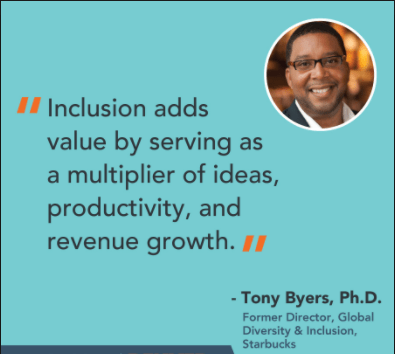
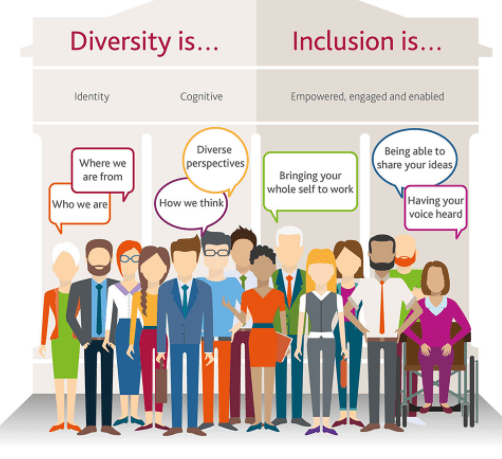
The day kicked off with Dr. Tony Byers discussing The Multiplier Effect of Inclusion. Engaging us with wit, humor and authenticity, Dr. Byers started by sharing a story from his childhood of being excluded, the lasting impact that feeling left on him and how the experience informs his work. Similarly to Maria Arcocha White, he briefly touched on how D&I work had been done for the past 40-50 years and how it needs to change.  Over time, he stated, counting heads became more important than making heads count. Organizations can be diverse without being inclusive but it’s inclusiveness that really gives them an advantage. To highlight this, he showed us the difference in outcomes between a cross-cultural group that is well-led and culturally competent vs. one that is poorly led. Guess which one performs better?

divinc

Using a 10 question activity he highlighted the implications for innovation and creativity when an organization lacks diversity and inclusion. Hint: There are no elephants in Denmark.  From there he went on to discuss the responsibility each of us doing work in the D&I space has for being a multiplier when it comes to inclusion. We have to take a leadership role in this push for change. How are we helping our organizations become/be/act differently if the answers to questions are always the same? Considering the impact of multipliers, we must ask ourselves what we will commit to doing to implement inclusiveness, not just diversity. My commitment is to develop and sustain an organizational culture in which everyone feels included, respected and valued. What’s yours?

KEY TAKEAWAYS:

  • The 3 C’s of Inclusive Behavior:
    • Curiosity – Thinking Differently
    • Challenge – Managing Personal Bias
    • Courage – Develop an Inclusive ‘Speak Out’ Culture
  • Diversity x Inclusive Behaviors x Innovation = Increased Market Success (Organizations with inclusive cultures outperform other organizations by 26%.)
  • Different voices lead to different ideas and different solutions.
  • We may not always get it right in our attempts to be inclusive but we can’t stop. (Example: Starbucks’ ‘Race Together’ campaign.)

FAVORITE QUOTE: Why do you have to have a business case to treat me right?

I attended two other sessions on Day 2 but they honestly deserve separate posts. Especially Dr. Steve L. Robbins who I could have listened to for HOURS. Stay tuned.

#NotAThoughtLeader


#SHRMDIV Day 1 : Change How You Think About Diversity & Inclusion

Despite having to wake up at the crack of dawn, nearly missing my connecting flight and fearing for my life on the taxi ride from the airport,  I FINALLY made it to San Francisco and the SHRM Diversity & Inclusion Conference in time for the afternoon sessions. At first glance, the two sessions I attended – Creating a Diversity Strategy Map: Converting Intangible Assets into Tangible Outcomes and Results and Inclusion: The Future of Diversity – didn’t have much in common other than both being about diversity. However, a similar idea ran through both sessions which was that we need to change the way we think about diversity and inclusion in order to be effective change agents.

The first session came from a data perspective – what we need to know, what we need to find out and how we need to convey that information to show and prove the ROI of D&I. There was a lot of math and formulas aka the necessary evils. The speaker, Dr. Edward E. Hubbard, stressed the importance of being able to show the impact D&I has on the bottom line (“organizations speak green”) using measurable, evidence-based data. As D&I professionals, we have to know what is needed by the organization from a business standpoint but also what the business needs from a D&I standpoint. He also stressed the importance of completing a needs analysis prior to developing a D&I strategy or initiative because “if there is no need, there is no benefit.”

KEY TAKEAWAYS:

  • A paradigm shift is needed in how we assess the utility of diversity.
  • Knowing what is important to the organization and what it wants to accomplish is key.
  • Diversity and inclusion initiatives must be measured by results, not activities.

FAVORITE QUOTE: You’re either at the table or on the menu.

The second session tugged more at the heartstrings than the purse strings. The speaker, Maria Arcocha White, started the session talking briefly about her experience growing up being teased because English is not her first language. She went on to discuss why we can’t stop at diversity but must focus on inclusion as well. In fact, her point of view is that the only way to get to true diversity in an organization is by starting with inclusion. Arcocha White gave us a bit of a history lesson on how organizational culture has evolved over time and explained how focusing on individuality is the first step in building the trust required to have genuine conversations.

KEY TAKEAWAYS:

  • Think beyond visible diversity i.e. race and gender.
  • Behave in ways that allow true diversity and inclusion to occur.  If people have negative perceptions of ‘diversity’ use different words.
  • Inclusion must be intentional.

FAVORITE QUOTE: Diversity is a fact; inclusion is an act.

Not related directly to sessions but I also had some really great conversations with vendors in the expo hall about the importance of employee happiness, being a straight ally and recruiting people with disabilities. All in all day one was a success. I expect nothing less from day two.

(Posted on SHRM Blog October 24, 2017)

#NotAThoughtLeader


Let’s Start with Decency

Lately I have engaged in several conversations (online and IRL) surrounding race, racism, diversity and inclusion, as I’m sure many of you have, given today’s political and social climate. These conversations have been with friends, colleagues and fellow HR professionals. Thankfully I associate with some pretty intelligent, thoughtful, decent individuals who can discuss heated topics without becoming heated (passionate maybe, but not heated) and/or resorting to insults or name-calling. Thankfully. But for many, these types of conversations can often devolve into a free-for-all that becomes focused on the individual rather than on the topic. Or facts.

decency4During these conversations I’ve heard many stories of “true colors” being shown by folks people considered friends or at least decent associates. It seems this past presidential election and the current White House inhabitant have made vile and divisive words and actions against the “other” (race, gender, physical ability, sexuality, you name it) more acceptable and folks are feeling free to let their bigotry flag fly. Nowhere does that flag fly higher than online where folks develop superhero levels of courage from behind the keyboard. What does this say about us as a society? What does it mean for us in the workplace? What does it mean for HR professionals? More pointedly, what impact do these beliefs, when held by HR professionals, have on the rest of us?

If you’re a recruiter or hiring manager who believes black people are intellectually inferior, or that immigrants don’t deserve to be here, or that homosexuality is a sin, or that people with disabilities are somehow less than capable, or that women should stay home barefoot and pregnant, that has to affect your decisions in the workplace, right? How could it not?

If you’re a speaker who speaks on HR topics at conferences, or a consultant, or write an HR blog, how do your views not seep into your work? And if they don’t what type of a psychopath are you? I jest. But, seriously.

This topic is heavy on my mind. Not just because I’m headed to SHRM’s Diversity & Inclusion Conference next week (yay!) But also because I feel this pattern of hateful thoughts, beliefs and discourse will only get worse before it gets better. On a grand scale. However on a smaller scale, on the scale that is within my own little sphere of influence, I commit to do my part to make the world, the HR profession and the workplace a better place to be. For everyone.

I’m far from perfect but I know I’m a good, decent person and I truly believe all of this starts from there. Decency, empathy, and compassion are the building blocks of humanity. The more we infuse those into HR, it will in turn have an impact on our workplaces (WorkHuman, anyone?) which are composed of individuals who are a part of the world community. It’s all connected.

I know this was a bit of a ramble but thank you for making it this far. More to come!

(Posted on SHRM Blog October 23, 2017)


MYTH: Teleworkers Aren’t Working

This topic has been on my mind for a while. I’m a huge fan of teleworking. HUGE. Or rather of giving employees the option to telework. It’s not for everyone and it doesn’t work for everyone- some people need more structure & guidance or don’t work well in isolation. It also won’t work for every job. However, I believe there are few office-based jobs that can’t be done from an alternate work site (AWS) at least some of the time with the right equipment. I have a hard time understanding why more employers aren’t on board with telework as a flexible work option. I’ve noticed some employers, even though they offer a telework option, place expectations on teleworkers that they don’t place on workers who are in the office.

tumblr_omedmchiYc1qjqn5qo1_1280

Every person I’ve spoken with (aka a slightly less than scientific study) who has at least one regular telework day tells me they are much more productive on those days, primarily due to not having to commute and there being fewer distractions. I also think teleworkers have a tendency to “overwork” so people in the office don’t think they’re slacking. This has always bothered me. Just because you may or may not be wearing pajamas doesn’t mean you’re slacking.

Why is there a perception that just because you aren’t at a desk in an office space your employer owns, you aren’t working as hard or as much? Heaven forbid you miss a call or don’t respond to an email immediately. Guess what – people miss calls and don’t respond to emails immediately when they’re in the office too. People play video games and login to Facebook and shop on Amazon and all kinds of other things IN THE OFFICE. I won’t even go into the amount of time wasted on meetings and random chitchat. Yet there’s this perception by many employers that in the office = working and not in the office = probably not working.

I always say the proof is in the pudding. Well, I don’t actually say that. Who says that? My point is, if a person is not performing or is under-performing, it doesn’t matter where they’re located. The proof will be in that they aren’t getting results or meeting their goals. People who aren’t motivated to work from an AWS probably aren’t that motivated to work when they’re in the office either. THAT is the real problem that needs to be addressed.

This is another one of those things that comes down to trust. Trust your people. If you don’t trust your people, think about why that is and what can be done to change it. Allow your people flexibility to the extent that it doesn’t pose a hardship to the business. If someone isn’t performing well outside of the office but performs well in the office, maybe teleworking isn’t for them. That’s OK. At least they were given the option. If someone isn’t performing in or out of the office, a conversation needs to be had surrounding that issue. Just please don’t assume that a person who is teleworking is not really working. Last, but certainly not least, please understand that teleworkers also need bathroom breaks, eat lunch, step away from the desk for a moment, might miss a call or not immediately respond to an email. Just like when they’re in the office. Don’t worry; they’ll get back to you. Just like when they’re in the office.

 work

Focus on What Matters (#SHRM17 Takeaway)

I had the pleasure of attending Neen James’ Smart Stage session at SHRM17. Nearly two weeks later her words of wisdom still stand out to me. I tweeted my key takeaways, because that’s what I do. See below.

Neen’s directive to only focus on what matters rings true for both personal and professional tasks/relationships. As an HR Department of One (DOO) it is especially important to be mindful of how we’re using our time i.e. where we focus our attention because there never seems to be enough hours in the day when you are responsible for benefits, employee relations, compliance, and on and on. None of which is done in a vacuum – things POP UP all the time.

The statement on email made me immediately rethink how/when I use email. I usually think of how intrusive emails are to receive but I rarely considered the intrusiveness of the emails I send. Not that I ever send emails that aren’t important of course, but it’s the principle. Do unto others and all that jazz.

Neen has written a book, Folding Time: How to Achieve Twice As Much in Half the Timewhich I intend to check out based on the strength of Neen’s presentation. With work, school, parent/Grammy duties, and attempting to have some degree of a social life (limited though it may be) I need to achieve all I can in the time I have. Now what to do with these next 15 minutes?

Your (HR) Voice Matters

This post is inspired by a Twitter conversation – as so many things are. I have an awesome Twitter tribe of HR professionals (#TwitterHR) that I interact with on a regular basis and many of them also have blogs (#HRBloggers.) Some are seasoned bloggers, others are newbies and others, like myself, fall somewhere in between. I’ve been blogging for YEARS in various iterations on various topics, but this blog is relatively new.

So I’m checking the timeline earlier and I see a tweet from Steve Browne asking us to share the HR blogs we’ve been reading. As tends to happen when Steve makes a request, the responses were fast and furious. I’m honored that this blog was mentioned by some along with others I knew about and others I haven’t yet had the pleasure of reading. This got me thinking – Wow. There really are A LOT of HR bloggers out there. It’s overwhelming. Then one of my HR tweeps (Twitter peeps) mentioned she wants to write a blog about everyday HR practitioner struggles as opposed to strategic HR and the other typical HR blog fare. I’m of a similar mindset but I often struggle with thinking “who really wants to read this?

sayitWhen I wrote a lifestyle blog there was less pressure to “inform.” I was just sharing my world and it was fun. However, in the realm of “professional blogs” I find myself wondering “Do I really need to add my voice to this? How many HR voices are too many? Nobody has time to read ALL the blogs; why would they read mine? Is it OK to sometimes just talk, not teach?” Yet when my friend said she wanted to write an HR blog just to vent, I told her every blog is different and everyone has a different point of view worth sharing. I realized I was talking to myself as much as I was talking to her.

ginsberg

I have so many posts in draft status because I convince myself that it’s not important enough or timely enough or it’s been written about already, etc. I’m writing this post as a reminder to myself as well as to anyone else who may have the same struggle that it’s fine to just do you. Not everyone is going to be a HUGE blogging star. Not everyone even wants to be (though a lot of people probably do. LOL.) It’s SO easy to get caught up in followers and retweets and building your personal brand and trying to be seen as a “thought leader” or “subject matter expert.” Don’t get me wrong, those things ARE important to a degree. But sometimes you just want/need to get the thoughts out of your head and there’s nothing wrong with that. Sure, you could keep them to yourself, but what fun is that?

So my message to you (and to myself) is YOUR HR VOICE MATTERS. They say there’s a lid for every pot, so there must also be a reader for every blog too, right? You won’t get every one but you’ll get the right ones i.e. the ones who find something special/interesting/inspiring about your voice and point of view. Let’s do this!


Should HR Pros Be Held to a Higher Standard?

As you know, I attended SHRM17 in New Orleans and had a blast. I’m so glad I took the plunge and invested in my professional development. Luckily I was able to take advantage of a discounted rate because I volunteered at SHRM16.

Screen-Shot-2014-05-15-at-11.54.06-AMThe entertainment for this year’s concert was Harry Connick, Jr. I like HCJ as much as the next person but I wanted to get out and explore New Orleans a bit rather than sit in the convention center after being there all day so I didn’t attend the concert. However, I did see quite a few comments about it on the conference community site. These comments were less about the concert itself and more about the behavior of the concertgoers. Behavior such as rushing the stage, standing in the aisles, taking photos – you know, typical concert behavior.

“Oh my goodness, I can’t believe HR professionals would behave this way!”

“HR professionals shouldn’t rush the stage to take photos! Photos weren’t allowed. How can you enforce rules at work and not follow them here??”

“I’ve never been so disappointed in a group of HR professionals!”

You get the gist. So I’m reading these comments thinking “are y’all serious?” Apparently, they were based on the responses to my query. This got me thinking – is there an expectation that people who work in HR should behave differently than others when outside of work? Are we, or should we be, held to a higher standard in our private/social lives because of our chosen profession? To add another layer to this, if this expectation exists, is it widely held or is it only held in some HR circles?

Don’t get me wrong, I have a couple of concerts lined up this year that I paid good money for and if folks decide to stand in the way and block my view, I’m gonna be peeved, to say the least. So I get that part. I definitely believe in exercising common courtesy and a basic level of decorum. Not because I work in HR, but because I’m a somewhat decent human being. Do unto others and all that jazz. But this mindset that working in HR should somehow influence your behavior outside of work threw me for a loop. Especially because I saw it from multiple people. That has never occurred to me.

So what say you, readers? HR by day, at night we play? HR always in all ways?

Let me know your thoughts.

#SHRM17 – ALL IN(SPIRED)

20170626_232854

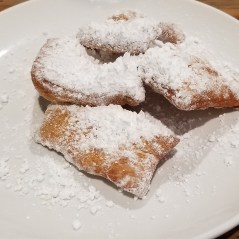
Beignets from Sunday brunch at Blake’s on Poydras. DELICIOUS!

SHRM 2017 ended last week and I’m experiencing withdrawal. The people, the sessions, the music, the BEIGNETS! What’s not to love? If you missed it, you missed something big. Literally. It was the biggest SHRM conference ever! Between the concurrent sessions, the Smart Stage, the Take 10s and the General Sessions, you could soak up a wealth of information without even trying.


Many of the sessions I attended shared the common theme of building trust, shifting culture, HR influence and putting people first. This was deliberate as these are topics that really speak to me and that I believe in fully. (Full disclosure: I ended up in Richard Fagerlin’s session because I was tired of walking that behemoth of a convention center. It was a great session though and I’m glad I attended it.)

I have a ton of takeaways from SHRM17. (I concur with Steve Browne’s statement that if you leave a session without any takeaways, it’s YOUR fault, not the speaker’s.) Some of my favorites are below.

TRUST YOUR PEOPLE.
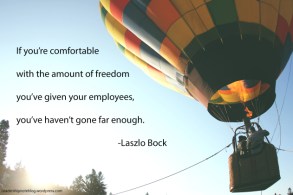
laszloIf you believe people are fundamentally good, you will treat them that way. (Laszlo Bock)

How many times have you encountered designated leaders who don’t trust the people they hire to do their jobs? You know who I’m talking about. The folks who want to micromanage their employees to death. Perhaps you are (gasp!) one of those people. If you are, stop it right now! That’s no way to inspire or motivate folks to be productive.

Another great Bock statement: FREEDOM IS FREE. Meaning, it costs nothing for you to allow your employees the freedom and autonomy to be effective. Let’s face it – if you don’t trust the people you hire, that says way more about you than it says about them.

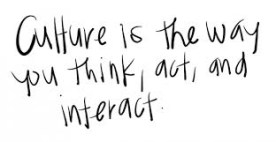
CULTURE IS THE SUM OF WHAT YOU PERMIT AND WHAT YOU PROMOTE.
culture

Another way to think about culture. Steve Browne said this in his session as well.

Consider the mic dropped.  This comment on culture from Richard Fagerlin’s session, Creating a Culture of High Trust : 10 Things Every Organization Must Do to Experience High Trust was probably my most retweeted tweet from the conference. Obviously it resonates.


We’ve all seen it. You have an organization that prides itself on its core values of  <insert  buzzwords of the moment> but in practice it’s a whole different story. They say they believe in diversity & inclusion, but the leadership team looks the same and thinks the same. They say they believe in innovation but new ideas are always shot down. They say harassment won’t be tolerated but a known harasser gets promoted because they are a high performer. They say they believe in work/life balance but pitch a fit if an employee has to leave early. I call shenanigans! Your culture isn’t what you say it is, it’s what it is.

Another good Fagerlin quote: EVERY ORGANIZATION IS PERFECTLY DESIGNED TO GET THE RESULTS IT GETS. Just let that marinate for a minute while thinking about some of your past (maybe present) work experiences. It’s all starting to make sense now, right? #MajorKey

THE KEY TO SUCCESSFUL LEADERSHIP IS INFLUENCE, NOT AUTHORITY.* 
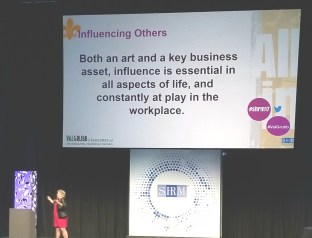
20170626_172813In her session, Influencing Others: 8 Steps to Get Results When You Don’t Have Direct AuthorityValerie Grubb spoke about how to influence others when you don’t have direct authority. Again, this really boiled down to trust. Trust and communication style.

In order to influence someone when you don’t have authority over them i.e. when you can’t say “because I said so,” they have to trust you (see above) and you have to communicate concisely. Speak to the WHY of what you’re trying to accomplish and gain a reputation for getting to the point. This is something I really need to practice. I can get wordy at times. (Don’t say it. LOL. Just keep reading.) WHEN TRYING TO INFLUENCE SOMEONE THEY HAVE TO HEAR YOU FIRST. If they don’t trust you, chances are they aren’t listening.

DON’T KEEP FOLLOWING THE RULES; CHANGE THEM!
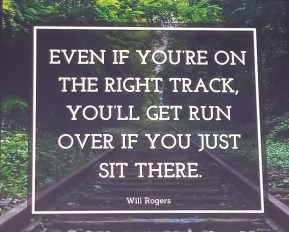
20170626_172212You probably guessed this quote came from Steve Browne without me having to say it. He has a bit of a reputation as a rule breaker. In a good way. Make that a GREAT way. Steve is so freakin’ inspirational and his passion for HR and people is contagious.

I attended Steve’s Brand Name HR: Giving Your Function Life & Purpose session. He spoke a lot about pushing boundaries and not letting yourself (and your career) be confined to what HR is “supposed to do” or “should be doing.” We need to challenge the status quo and not be afraid to shake things up for the betterment of the folks we’re here to support.

We can’t be afraid to bring our whole selves to work and we must encourage others to do the same.  We spend too much time at work to have to shut off or hide major parts of ourselves during the workday. For example, I like to change my hair color a lot and I have visible tattoos. Neither of which impacts my ability to do my job. Get over it.

Steve also talked about HR being out and among the people as opposed to always making them come to us. I’m proud to say I do a pretty good job of this. The people are the reason I do what I do. Why would I want to keep my distance from them? I have never been “Ms. Stuffy, Scary, Uncaring HR lady” and I never will be. Let’s not be confined by others’ preconceived notions of HR. IF YOU’RE NOT MAKING PEOPLE UNCOMFORTABLE YOU’RE NOT DOING YOUR JOB. (Thanks for the reminder, Steve!)

20170619_223633

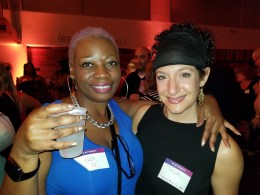
IRL connection w/ @tgweeded – photobomb courtesy of @cescobar78

This was just a small taste of my #SHRM17 experience. There’s no way I can cover it all in one blog post. However, I would be remiss if I didn’t mention how fabulous and fun it was to make IRL connections with the folks I know from #nextchat. (Not familiar? Get into it! Every Wed. 3pm EST on Twitter.) It was so great to put a human-sized face to a tiny Twitter avatar face and take our conversations offline. That was easily one of the best parts of the conference.


So SHRM17 has come and gone. Beignet cravings notwithstanding, I’m excited about sharing and implementing what I learned and continuing to connect with other HR professionals, online and off. I went ALL IN and came out truly INspired. Kudos to the entire SHRM team for a WONDERFUL conference!! I hope to see everyone at #SHRM18 next year. (I wonder if there’s any chance of having a batch of beignets shipped to Chicago.) 

BONUS ROUND: If you attended SHRM17, share your favorite part in the comments and/or reach out to me on Twitter @tmrasberry.

*Ken Blanchard quote

(Posted on SHRM Blog June 28, 2017)

#WorkHuman? How Else Are We Gonna Work?

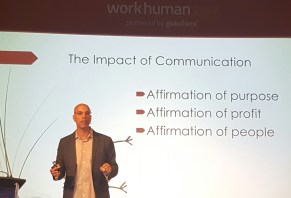
20170605_014829If you follow me on Twitter (and you should 🙂 ) you know I spent the better part of last week attending the WorkHuman conference in Phoenix, AZ. I expected it to be good but it shattered my expectations. The event was AMAZING and I am very much looking forward to being able to attend WorkHuman 2018.

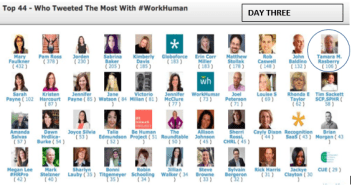
I chose to attend sessions that focused on communication, authenticity, gratitude, recognition, diversity and inclusion. I took copious notes and tweeted some key takeaways. (See below; I was kind of a big deal. Lol.)

day3wh

I learned too much and gained too much inspiration from WorkHuman to contain it all in one blog post. Consider this compilation of some of my favorite quotes  as part one of a series.

Have the courage to speak softly.Susan Cain, Author & Lecturer

We all want the same things in life, to be seen and appreciated for who we are.Chaz Bono, Actor & Advocate (The title of this post also references a Chaz Bono quote.)20170605_014136

In a culture where people can only bring solutions, you won’t hear about the biggest problems. – Adam Grant, Author & Professor

20170605_014924


Have people stay in their lanes if that’s where they show excellence.  –  John Baldino, President, Humareso

At the end of the day we’re all humans. Treat everyone as individuals and the workplace will benefit.Dan Schawbel,  Workplace Expert

At the end of the day people want to have pride in what they do.Chinwe Onyeagoro, President, Great Place to Work

   20170605_014010

More WorkHuman goodness to come!

Life Lesson: Gratitude

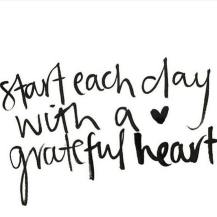
happiness-via-gratitude-quote_daily-inspirationI have a wall hanging next to my bed that reads “Start Each Day with a Grateful Heart.” I placed this next to my bed so that I couldn’t help but see it every morning. It’s so easy to get caught up in the day-to-day drama of work, family and other responsibilities that we might forget to be grateful for our life experiences, relationships, lessons learned, skills & talents, etc.
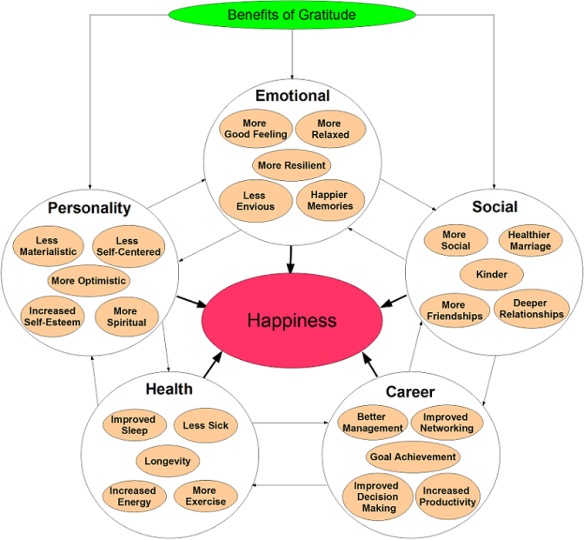
At the WorkHuman conference I attended last week, they had an area called the ‘Gratitude Bar.’ The purpose of this was to recognize other people who were in some way helpful to you during the conference. There were four categories in which you could recognize someone: Happiness, Enlightenment, Inclusion and Authenticity. The idea was to show gratitude by recognizing someone in the moment. This concept was designed to replicate social recognition in the workplace.

How often do you take the time show gratitude in either your personal or professional life? It’s important for our own well-being to BE grateful but it’s equally important for our interactions and relationships with others to SHOW gratitude.

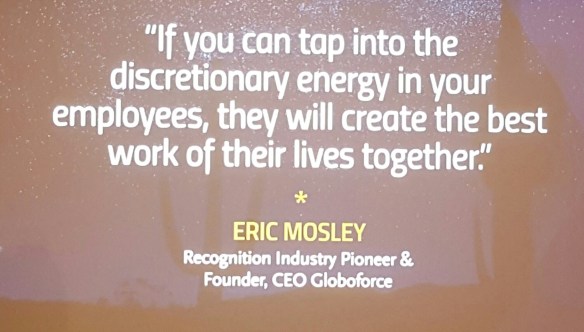
In the workplace, employee recognition has a significant impact on employee engagement and happiness as well as retention.  One of the WorkHuman sessions I attended was titled “Isn’t Thank You Enough?” The answer is no. A thank you is better than no thank you but after a while a thank you alone is meaningless.

By implementing gratitude into company culture, employees are more willing to spread their positive feelings with others, whether it’s helping out with a project or taking time to notice and recognizing those that have gone the extra mile. Employee recognition and appreciation can also create unique company culture and strengthen employee relationships.- The Psychological Effects of Workplace Appreciation & Gratitude, O.C. Tanner

Your assignment today folks, is to practice an attitude of gratitude in both word and deed. Let me know how it goes.